


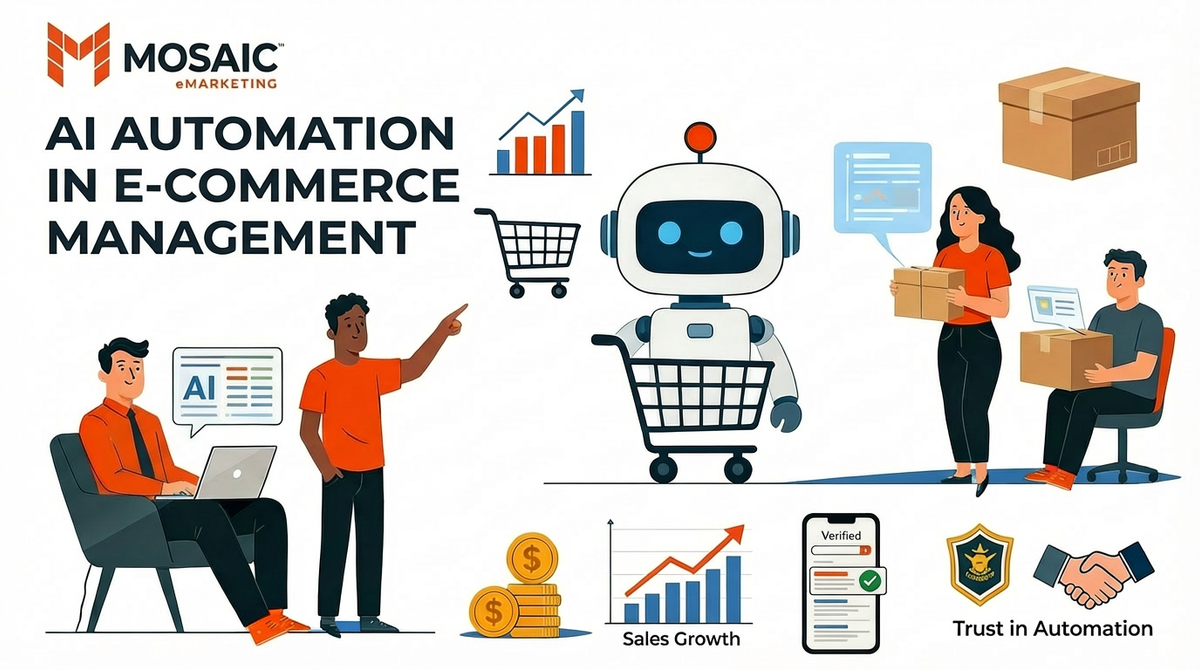
How AI Is Changing E-commerce Management
January 5, 2026
For most of the past decade, e-commerce growth has been driven by experimentation.
New channels. New creatives. New offers. New tools. Test, learn, iterate — repeat.
That approach worked when digital commerce was still expanding faster than operational complexity. But today, many e-commerce brands are discovering a hard truth:
The constraint on growth is no longer traffic or tools — it’s decision-making.
As SKU counts expand, margins tighten, and competition increases, the old model of human-driven optimization starts to break down. The problem isn’t lack of data. It’s the inability to govern that data at speed and at scale.
This is where AI is beginning to fundamentally change how e-commerce is managed. What’s changing now is not just how decisions are made and optimizations get done — but “who” (or what) makes them.
We’re seeing leading e-commerce operators move away from manual, campaign-based optimization toward governed systems that continuously evaluate and act across the business.
Governance, in this context, means:
- Clear rules and constraints
- Continuous evaluation of outcomes
- Automated execution where appropriate
- Human oversight at prescribed checkpoints
Where AI Creates Leverage in E-Commerce
AI’s real value in e-commerce is not “slop” content generation or flashy visualizations. It’s in decision execution — particularly in areas that are too dynamic, too large, or too complex for humans to manage at scale.
The highest-impact domains include:
- Pricing (governance and testing)
- SKU-level optimization
- Inventory-aware merchandising
- Promotion timing and depth
- Demand-signal interpretation across channels
AI excels in these lanes not as a replacement for e-commerce expertise or strategy, but as an extension of it.
Properly integrating AI with e-commerce matters. For marketing teams, this shift has a downstream effect. When pricing, inventory, and merchandising decisions are governed intelligently:
- Paid media becomes more efficient
- Creative testing has clearer signals
- Attribution improves (because inputs stabilize)
- Forecasting becomes more reliable
In other words, better governance upstream produces better performance downstream.
At Mosaic eMarketing, our role has always been to help clients move beyond surface-level optimization and into durable systems for growth. That’s why we’re increasingly focused on how to make better marketing decisions at scale, not just how to “optimize campaigns.”
As part of that evolution, we’ve entered an e-commerce partnership with Tellis.ai — a platform built specifically around AI-driven e-commerce optimization. At the core of this partnership is a systems approach that reduces decision latency, enforces intelligent constraints, and allows teams to focus on strategy and customer experience.