

Data-Driven Strategies to Increase Online Visibility and Generate Leads
October 22, 2025
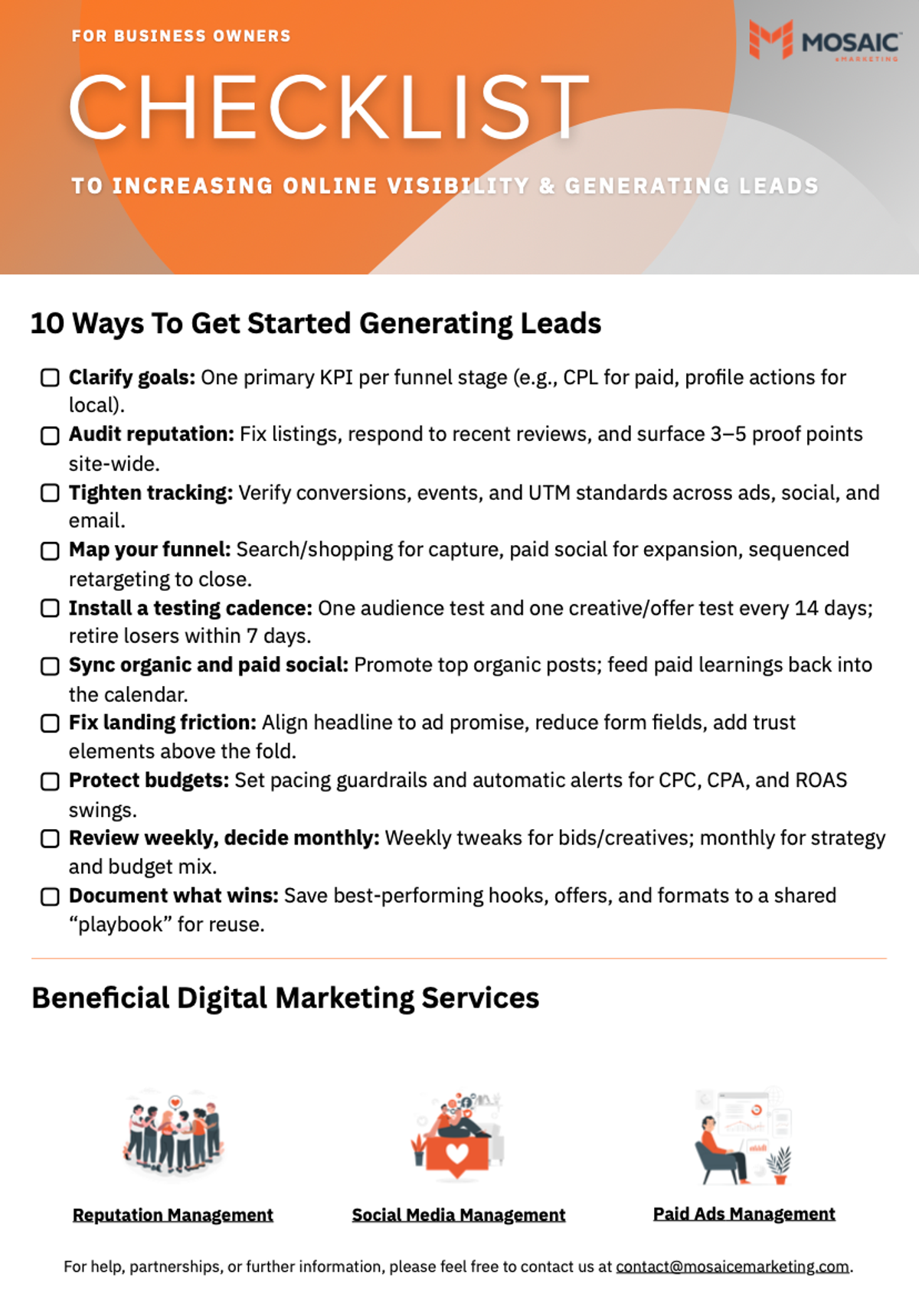
TL;DR: Increase visibility and leads by aligning three levers—reputation (trust signals), social (awareness → demand), and paid media (intent capture). Measure with clear KPIs and a regular test cadence. Start with reviews, listings, high-intent search, and one retargeting sequence. But you don’t have to do it alone, contact us or download our checklist.
How to Turn Visibility into Pipeline with Reputation, Social, and Paid Media
Data-driven digital marketing strategies turn casual searchers into sales conversations by aligning message, audience, and measurement. When your brand shows up with the right message for the right audience—backed by clean analytics—visibility compounds and leads get more qualified. This guide breaks down how Mosaic eMarketing unifies reputation, social, and paid media into a single growth engine you can measure and scale.
Why a Data-First Approach Wins—Consistently
Data is more than reporting; it’s an operating system for your marketing. A data-first approach answers three questions every week:
- Who are we targeting—and why now? Segment by intent (research, compare, ready-to-buy) and match creative and CTAs to each stage.
- Where should the next dollar go? Balance high-intent channels (search, shopping) with audience expansion (paid social), then retarget to capture demand efficiently.
- What’s working—and what’s next? Let test results (headlines, offers, visuals, audiences) guide the next sprint so your cost per lead trends down over time.
When reputation signals, social engagement, and paid performance are read together, you reduce waste, increase relevance, and build momentum that lasts beyond any single campaign.
Reputation Management: Build Trust, Earn Clicks
Before people convert, they check your reputation. Strong reviews, accurate listings, and optimized business profiles increase click-through rate, lift local visibility, and set the tone for every ad and organic impression.
What to focus on
- Reviews & responses: Treat reviews as public proof. Establish SLAs for responses, highlight service recoveries, and curate top quotes into site content and ads.
- Listings & local signals: Ensure consistent NAP across directories, optimize Google Business Profiles, and maintain category/attribute accuracy—small fixes with outsized impact on discovery and calls.
- Sentiment into messaging: Mine recurring themes from reviews and support tickets. Use the language customers love (and the objections they raise) to shape ad copy, headlines, FAQs, and social posts.
How Mosaic eMarketing helps
- Continuous monitoring and escalation workflows so issues don’t linger.
- Profile and listing optimization to strengthen local search presence and branded CTR.
- Insights hand-off into social and paid teams, so trust signals carry through to creatives and landing pages.
Want a quick read on where your reputation stands? Check out our Reputation Management services.
Social Media Services: From Awareness to Demand You Can Measure
Social is where your audience discovers, compares, and decides. A data-driven social program turns that journey into a measurable pipeline.
Audience & Creative Testing
We start with hypotheses and prove them fast. Test hooks, formats (video, carousel, static), CTAs, and value props by audience segment. Keep winners, cut the rest. This lowers cost per result over time and informs messaging across channels.
Organic–Paid Synergy
Let organic insights shape paid—then amplify the best posts. Use paid social for net-new reach and retargeting, while organic builds authority and community. Share learnings regularly so both tracks improve together.
Community Management & Social Proof
Quick, human responses reduce friction and protect trust. Elevate UGC, testimonials, and FAQs into content series. Treat comments and DMs as conversion cues—not noise.
How Mosaic eMarketing helps: Strategy, creative testing, content calendars, paid amplification, and community management under one roof—so every post has a job and every dollar is accountable.Explore our approach: Social Media Marketing
Paid Media Management: Efficient, Scalable Lead Gen
Paid media should create predictable outcomes, not surprises. We design for intent, then optimize daily.
Full-Funnel Structure (Search, Social, Shopping, Retargeting)
Capture ready demand with high-intent search and shopping. Build demand with paid social prospecting. Re-engage with sequenced retargeting that addresses objections and drives next steps.
Budget Pacing, Bids & Offer Testing
Allocate spend to proven keywords, audiences, and creatives. Use bid strategies matched to funnel stage and data depth. Test offers (bundles, consultations, value-adds) and lean into what converts—especially around promotions or seasonal spikes.
Landing Page Alignment & CRO
Clicks don’t equal conversions. Align headlines, proof points, and forms with ad intent. Reduce steps, speed up pages, and surface trust elements (ratings, guarantees, FAQs). Small CRO wins compound media efficiency.
How Mosaic eMarketing helps: We manage search and shopping to maximize qualified traffic, integrate learnings with social, and provide clear pacing and performance visibility.See our program: Search Engine Marketing
Measurement That Drives Decisions
Reporting should guide action, not just summarize yesterday. We set up measurement so you can see what’s working, what’s wasting spend, and where the next dollar should go.
Attribution that Fits Your Sales Cycle
Pick a model that matches how your buyers decide. For shorter cycles, data-driven or position-based attribution often reveals the real assist value of social and retargeting. For longer cycles, compare models (first click, last click, data-driven) to understand how channels contribute at each stage. We align attribution choices with your goals, then document how decisions get made so everyone is on the same page.
Dashboards You Can Trust
Centralize sources. Pull paid, social, web analytics, and CRM into clear dashboards with weekly and monthly views. Show leading indicators (CTR, CPC, thumb-stop rate, add-to-cart) next to outcome metrics (MQLs, SQLs, revenue) so you can course-correct fast. We highlight anomalies, wins, and next tests—so reports lead to action, not meetings.
KPIs that Ladder Up
Define a small set of KPIs per funnel stage:
- Reach & discovery: Share of voice, branded CTR, local profile actions.
- Engagement & consideration: Quality traffic, session depth, social saves/shares, add-to-cart.
- Conversion & revenue: Cost per qualified lead, pipeline created, ROAS/POAS.We agree on thresholds and pacing rules upfront, then adjust based on seasonality and offer performance.
Quick-Start Checklist (10 Items)
Want momentum without a rebuild? Start here.
- Clarify goals: One primary KPI per funnel stage (e.g., CPL for paid, profile actions for local).
- Audit reputation: Fix listings, respond to recent reviews, and surface 3–5 proof points site-wide. → Reputation Management
- Tighten tracking: Verify conversions, events, and UTM standards across ads, social, and email.
- Map your funnel: Search/shopping for capture, paid social for expansion, sequenced retargeting to close.
- Install a testing cadence: One audience test and one creative/offer test every 14 days; retire losers within 7 days.
- Sync organic and paid social: Promote top organic posts; feed paid learnings back into the calendar. → Social Media Marketing
- Fix landing friction: Align headline to ad promise, reduce form fields, add trust elements above the fold.
- Protect budgets: Set pacing guardrails and automatic alerts for CPC, CPA, and ROAS swings. → Search Engine Marketing
- Review weekly, decide monthly: Weekly tweaks for bids/creatives; monthly for strategy and budget mix.
- Document what wins: Save best-performing hooks, offers, and formats to a shared “playbook” for reuse.
FAQs
What is a data-driven digital marketing strategy?It’s a process that uses verified customer and performance data to decide audiences, messages, channels, and budgets—then iterates every two weeks based on results.
How do I increase online visibility quickly?Start with accurate listings and reviews, high-intent search campaigns, and one remarketing sequence. Then scale via paid social prospecting and consistent content.
Which KPIs matter most for lead generation?By stage: branded CTR and profile actions (visibility), qualified traffic and saves/shares (consideration), cost per qualified lead and pipeline created (conversion).
How should I split budget across channels?Allocate a base to high-intent search, add paid social for net-new reach, and reserve a remarketing budget. Rebalance monthly based on CPA/ROAS and pipeline quality.
Do I need separate landing pages for each campaign?Yes—match headline and offer to the ad’s promise, surface trust signals, and remove friction. Small CRO wins compound paid efficiency.
Next Steps
Visibility without intent is noise. Intent without trust is a dead end. When reputation, social, and paid media work from the same data, you generate leads you actually want—and you can prove it.
If you’re ready to align these pieces, start where the impact is immediate:
- Strengthen trust with Reputation Management.
- Turn attention into demand with Social Media Marketing.
- Scale qualified traffic with Search Engine Marketing.
Get a data-driven growth plan. We’ll review your current visibility, lead flow, and tracking, then deliver a prioritized roadmap with testing ideas, budget mix, and KPIs.